AI Infrastructure Platform

Beyond the
grid.

AI compute infrastructure that adds to the grid instead of competing for it. Captive power, edge compute, and continuously-learning orchestration — engineered as a single platform, deployable where standard interconnects can't deliver in time.

Power Nobelity AB PowerTo AI · Sweden 2026
Scroll
01 The constraint

The grid is the bottleneck.
Not capital.

AI infrastructure is the largest capital project of the decade. The constraint isn't money — it's power, and the queues to access it. Interconnect timelines have stretched from months to years across every major market.

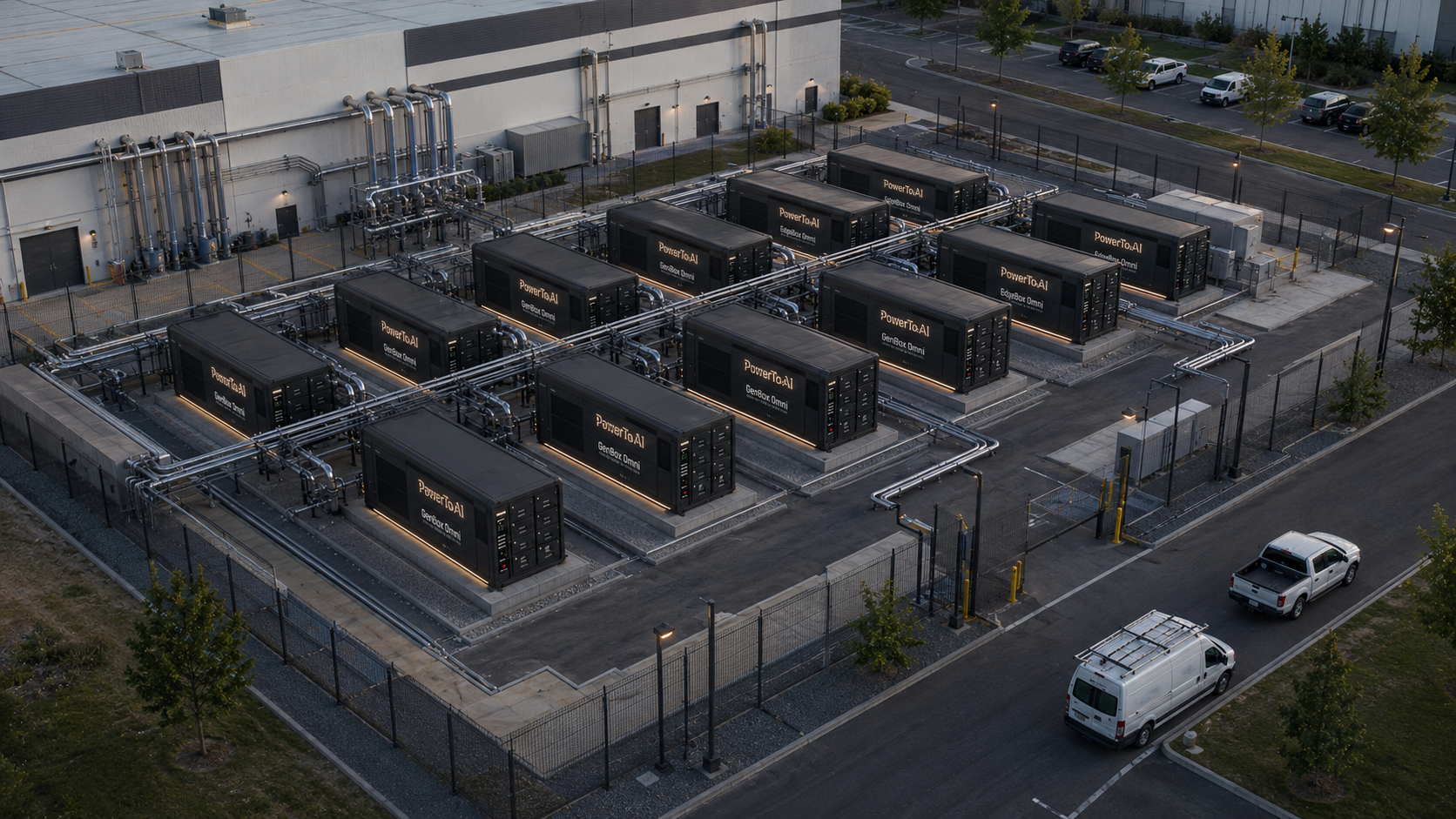
PowerTo AI removes the queue from the equation. Captive generation, edge compute, and ML orchestration arrive pre-integrated, deployable to host sites or behind-the-meter campuses in 12–18 months — and built so every site adds grid capacity, heat, cooling, EV charging, and grid services into the local system rather than subtracting from it.

5–7yr
Grid interconnect
Typical wait times for new large-load interconnection across major US and EU grids.
$300B+
Capex committed
Hyperscaler AI infrastructure spending committed over the next three years.
100GW+
Integrated multi-utility
Parallel addressable market for integrated infrastructure by 2030 — capacity that doesn't depend on the grid.
02 The platform

Three integrated layers.
One deployable system.

Each layer can stand alone. Together, they deliver AI compute capacity that the grid cannot.
GenBox Omni
01 / 03
Captive power

GenBox Omni

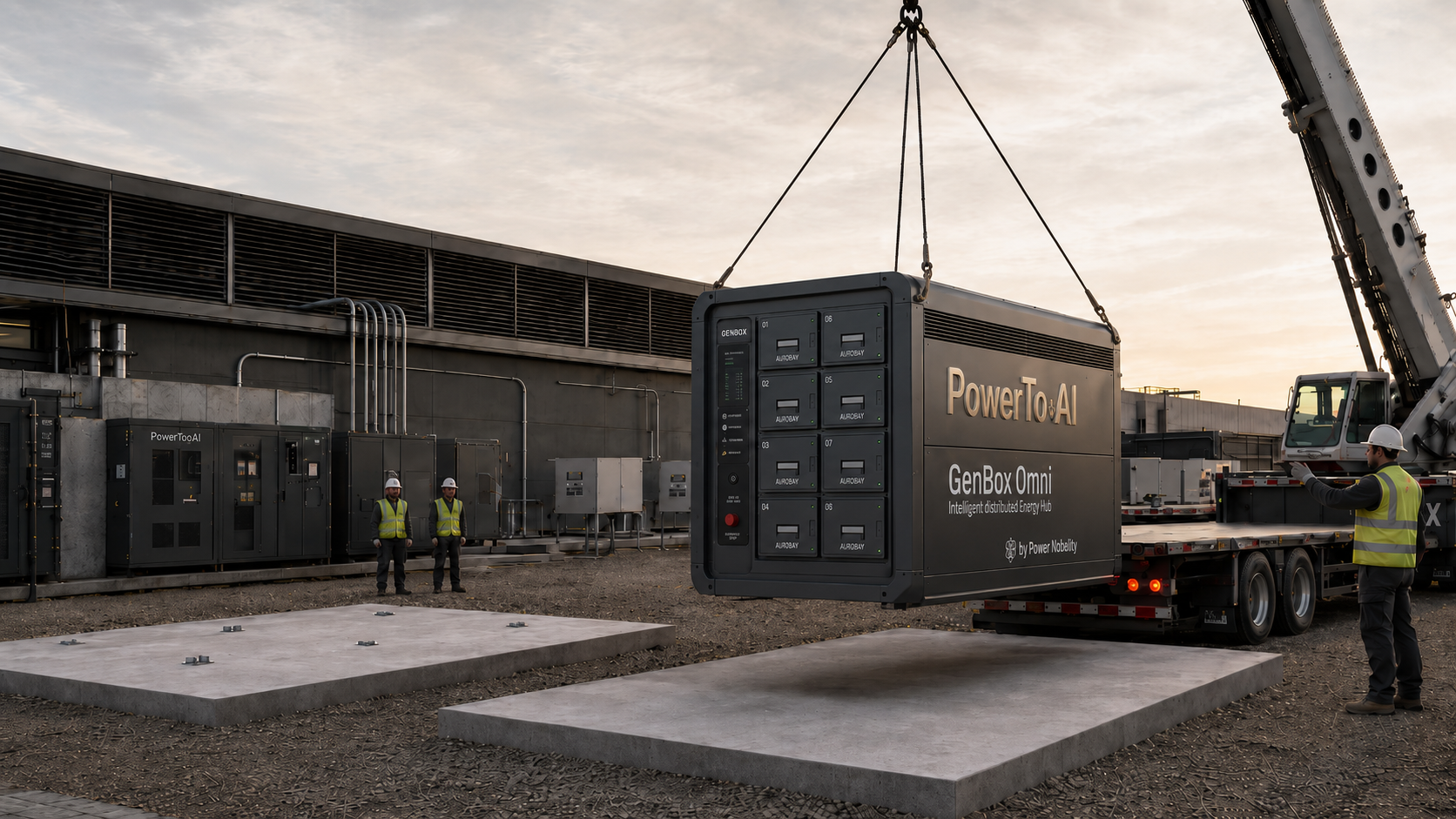
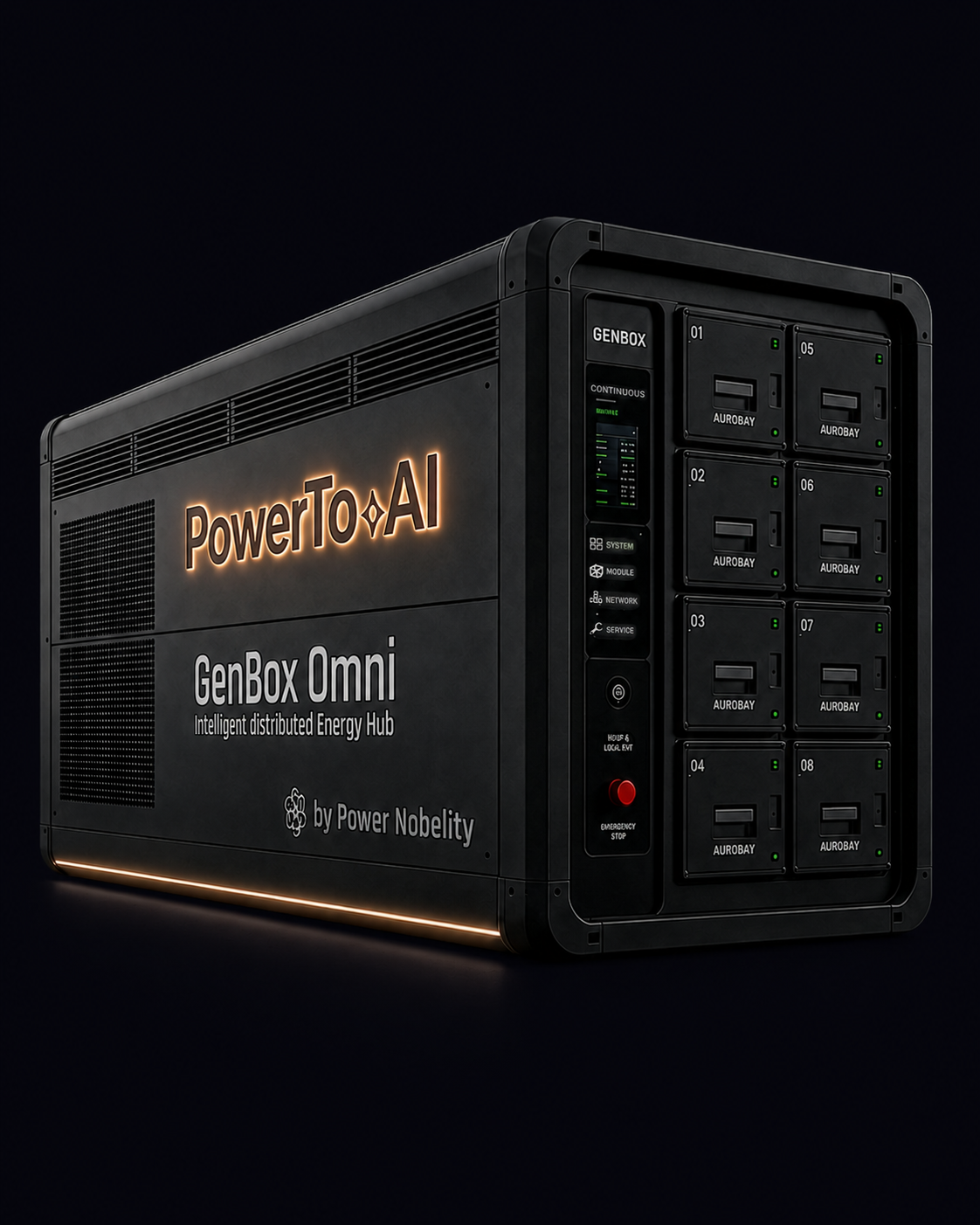
A containerised energy hub delivering electrons, heat, cooling, and water recovery. Multi-fuel capability spans natural gas, biogas, e-methanol, and hydrogen blends. Engineered for behind-the-meter deployment.

ElectricalUp to 1 MW
Storage1 MWh + 6 MWh thermal
FuelFlex (NG → H₂)
Pre-production · 2026
EdgeBox Omni
02 / 03
AI compute

EdgeBox Omni

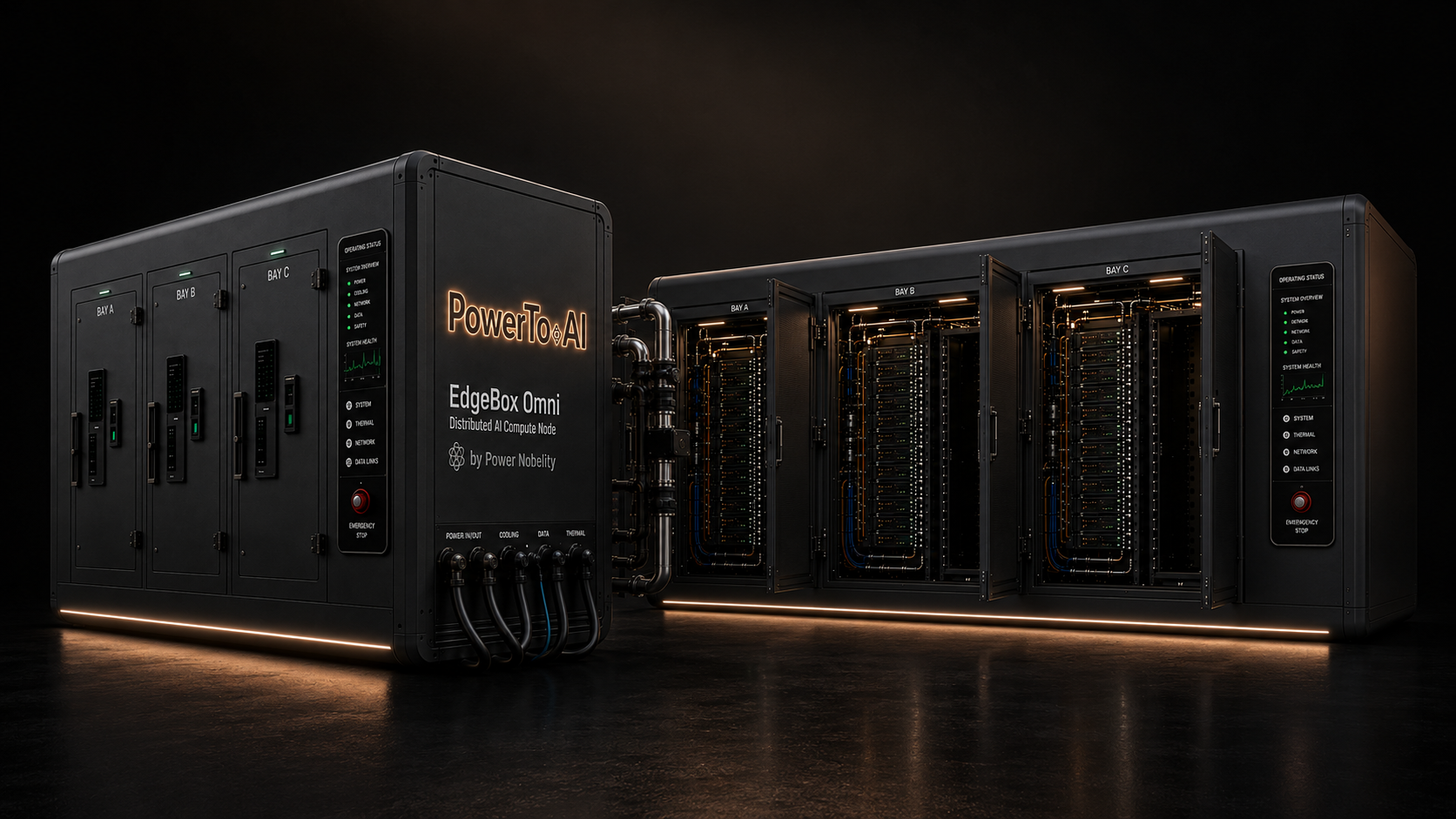
A containerised distributed compute node. Up to 1 MW IT load, direct liquid-cooled, with three tenant bays and Tier III-equivalent resilience. Thermally coupled to the GenBox so heat returns into the energy loop.

IT loadUp to 1 MW
CoolingDirect liquid
Tenant baysThree (A / B / C)
Pre-production · 2026
Orchestration

AI Orchestration

The software intelligence layer at the core of the platform. A four-layer control architecture coordinates energy generation, thermal services, and compute workloads — autonomously, in real time, across the fleet.

RoleAutonomous coordination
ArchitectureFour-layer control
03 Fleet Intelligence

Software-defined power.
Driven by ML.

Hardware is only half the equation. The orchestration layer acts as the central nervous system bridging digital workloads with physical energy realities in real time — autonomously, across the fleet.

Predictive Power Dispatch

Time-series forecasting models predict incoming compute workloads and localized grid conditions. GenBox preemptively adjusts its multi-fuel generation hours ahead of demand spikes, holding power stability without grid reliance.

Time-Series Forecasting

Autonomous Thermal Routing

A reinforcement learning agent continuously seeks the lowest-PUE operating state, adjusting liquid cooling flow and workload placement based on real-time thermal storage state and compute heat output.

Reinforcement Learning

Federated Fleet Insights

Operational model weights — not raw tenant data — are aggregated across the fleet. The platform sharpens its predictive algorithms collectively without compromising tenant data sovereignty.

Federated Learning
04 Systemic Yield

Efficient. Resilient.
By construction.

Conventional infrastructure treats sustainability and resilience as separate problems — solved with offset credits on one side and diesel backup on the other. The PowerTo AI platform delivers both as emergent properties of the same architectural choice. Each site is built to add capacity to its local system rather than draw from it — the parasitic load inversion the grid increasingly requires from large-load buyers.

01 / 03

Self-generation

Energy produced on-site, sized to the compute load. No transmission distance. No interconnect dependency.

Efficiency
Zero transmission losses end-to-end
Resilience
Operates independently of grid uptime
02 / 03

Storage on both axes

1 MWh electrical, 6 MWh thermal — generation decoupled from demand on both axes. Electrons and joules buffered, dispatched on need.

Efficiency
Waste heat captured and reused at high grade
Resilience
Ride-through capacity across demand spikes
03 / 03

Two-way grid interplay

Absorbs grid surplus that would otherwise be curtailed. Supplies frequency, voltage, and capacity services back when the grid needs them.

Efficiency
Recaptures otherwise-lost renewable surplus
Resilience
Each site operates as a grid-positive asset
Representative 24h dispatch · 1 MWe / 1.25 MWth GenBox
Simulation loop
M1 · Direct Delivery 00:00

Engines running. Output flows direct to consumers. Heat + electricity matched to demand.

Inputs
Fuel2,500kW
Grid (net)0kW
Storage state
Battery75%
Thermal65%
Energy users
EV charging200kW
EdgeBox (elec)600kW
EdgeBox (heat)240kW
Buildings (elec)200kW
Buildings (heat)1,010kW
INPUTS PLATFORM ENERGY USERS FUEL 2,500 kW · 0–1000 range NG · BIOGAS · e-METHANOL · H₂ GRID 0 kW · ±1000 bidirectional — STANDBY FUEL GRID GENBOX OMNI CONVERSION · STORAGE · DISPATCH LIVE STATE Electricity · 1 MWh 75% Thermal · 3 MWh 65% ROUTING LOGIC ABSTRACTED · IP-PROTECTED DISPATCH · M1 + GRID SERVICES FCR · mFRR · aFRR · ±1 MW + WATER RECOVERY ~120 L/hr scrubber condensate ELEC ELEC THERMAL ELEC THERMAL EV + AUXILIARY 200 kW ELECTRICAL EV chargers · DC-Box · site loads EDGEBOX 600 kW · ELEC 240 kW · THERMAL AI compute · waste heat returned ↻ THERMAL SYMBIOSIS BUILDINGS 200 kW · ELEC 1,010 kW · THERMAL Heat · cooling · DHW · peak-shaving District / commercial / mixed-use
Dispatch Spot €/MWh Heat kW
00:00 06:00 12:00 18:00 24:00 11:38 · M1
What the visualization shows: a representative 24h dispatch cycle compressed into 30 seconds. 1 MWe / 1.25 MWth GenBox with 1 MWh battery and 3 MWh thermal storage routes fuel and grid energy to EV, EdgeBox, and Buildings as the spot price and heat demand shift. The platform absorbs grid surplus overnight (M4), banks battery + thermal storage in cheap hours (M2), delivers directly at moderate load (M1), and exports / discharges storage at peak (M3). The ~90% total system efficiency is the aggregate across this cycle, not a single-moment ratio.
Total system efficiency
~90%

Same useful work, less fuel input, less exhaust output — whatever the fuel.

Reporting
The architecture generates the hour-by-hour generation accounting required for 24/7 carbon-free energy matching, and the structured telemetry required for EU CSRD reporting. Compliance follows the engineering, not the other way around.

Infrastructure that runs when the grid doesn't.

05 Deployment

Two modes.
From the edge to the centre.

The platform deploys as a host-site installation or as a dedicated behind-the-meter campus. The same hardware, two configurations — covering the full geometry of AI compute demand.

Distributed deployment
Distributed model

Edge compute
at host sites

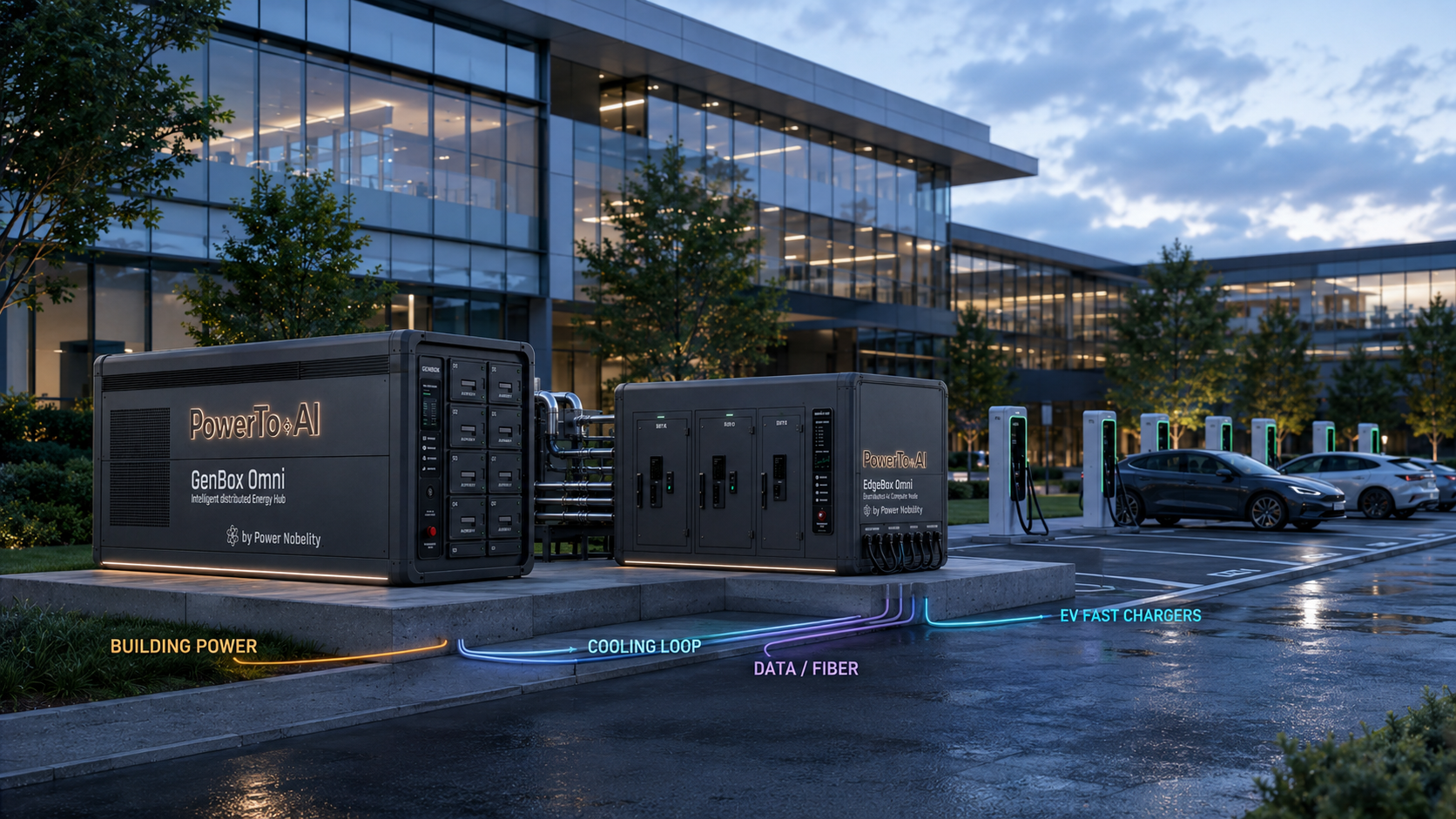
One GenBox plus one EdgeBox co-located at a mixed-use building, retail cluster, or industrial park. Ms-latency AI compute at the edge, with heat, cooling, EV charging, and grid stabilization absorbed by the host as integrated co-benefits.

Configuration
1 × GenBox + 1 × EdgeBox
Host profile
Mixed-use, retail, industrial
Compute
Edge / inference
Distributed brief
Dedicated deployment
Dedicated model

Behind-the-meter
AI campuses

Multiple GenBox and EdgeBox units co-located at a dedicated site. Hyperscaler-grade AI compute capacity that bypasses grid interconnect queues entirely. Sovereign-grade deployment, jurisdiction-agnostic.

Configuration
Multi-unit campus
Tenant profile
Hyperscaler, sovereign AI
Compute
Training + inference scale
Dedicated brief
06 Outcomes

What gets delivered.

Outcomes the platform commits to. Not internal mechanism — what arrives on site.

Speed-to-power

From signed deployment brief to first MW delivered in 12–18 months — independent of interconnect queue position.

Time-to-energy

AI compute capacity

MW-scale liquid-cooled compute, multi-tenant, with Tier III-equivalent resilience and edge-to-campus deployability.

IT load

Sovereign deployment

Domestic AI compute capacity deployable into any jurisdiction with energy autonomy from grid policy and import dependencies.

Jurisdiction-agnostic

Captive power

Behind-the-meter generation with multi-fuel flex — natural gas, biogas, e-methanol, hydrogen blends — sized to the load.

Energy autonomy

Heat & cooling

High-grade thermal output and cooling capacity available to host sites as integrated co-benefit — district loops, process heat, HVAC.

Multi-utility

Grid services

Frequency, voltage, and capacity services available to the local utility — turning host sites into grid-positive assets.

Grid-positive

Water recovery

Water-positive cooling architecture — recovered from combustion and compute waste streams rather than consumed from supply.

Water-positive

Single service

One platform supplier across captive power, edge compute, and fleet orchestration — no system integrator stack to assemble.

Operational simplicity

No capital expenditure

Customers pay for delivered power, heat, and AI compute capacity. PowerTo AI owns, deploys, and operates the platform.

Energy-as-a-service
07 Engage

How to work with us.

We work with four categories of partner. Direct conversations only — no intermediated processes.